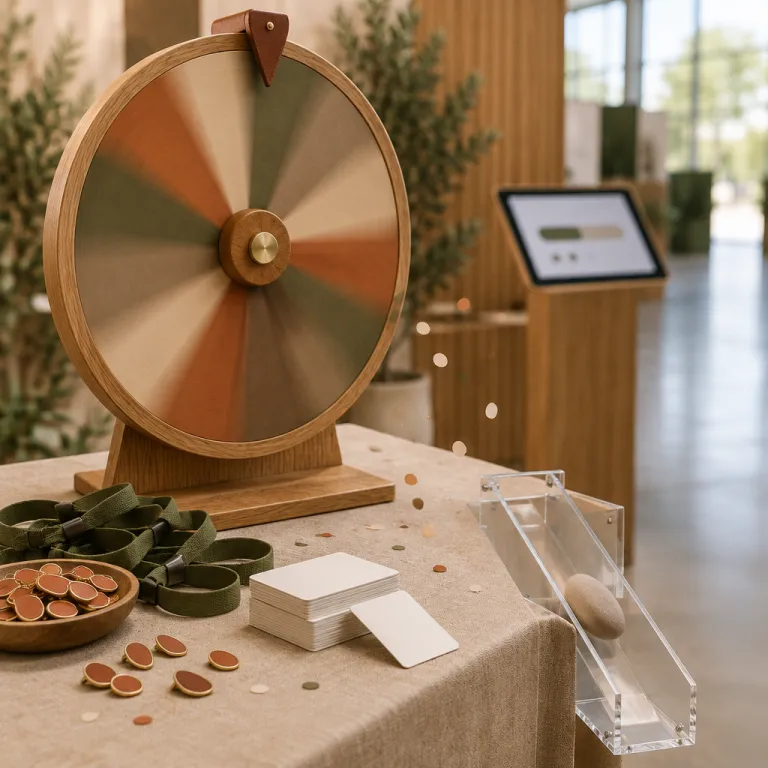
From passive stand to performance engine: why gamification now defines booth engagement
Australian exhibitors who still rely on static displays are leaving measurable engagement gains on the table. When structured games are integrated into a booth, industry benchmarks from event technology providers and agency case studies commonly report increases in booth visitors of around 30–40 percent and higher attendee engagement of 60–80 percent, which aligns with what many event marketing teams now see on the show floor. For example, a 2023 analysis by Cvent and Freeman on interactive exhibits found that stands using game mechanics and digital challenges attracted roughly one-third more unique visitors than comparable non-interactive booths, while a multi-show study by GES on experiential exhibits reported engagement uplifts of more than 70 percent when games were tied to product education. That shift turns a booth from a branded backdrop into an active exhibit where attendees, visitors and staff co-create an experience that directly supports lead generation.
Gamification at a trade show means more than a random game or prize wheel; it is a strategy that uses game design elements such as points, leaderboards, timed challenges and rewards to influence behaviour and deepen engagement. On a busy show floor in Sydney, Melbourne or Brisbane, these interactive experiences give attendees a clear reason to engage with your brand instead of neighbouring stands that still rely on brochures. Because interactive games structure the conversation, they also make lead capture more consistent, more compliant and easier to integrate into CRM workflows for post-event nurturing.
Data from specialist agencies and published event case studies suggests that interactive exhibits are more than 50 percent more likely to attract attendees than non-interactive stands. In a 2022 report on digital engagement, for instance, an event technology vendor documented that gamified booths generated roughly 35 percent more scanned contacts and that attendees retained about 40–50 percent more information when the experience was delivered through games rather than a standard demo, echoing findings from learning and development research on active participation. For B2B brands selling complex products or services, that retention advantage means people remember your value proposition long after the event, which is exactly where many Australian trade show investments currently underperform.
What counts as gamification on the show floor and why it works
Not every game on a show booth qualifies as effective engagement, because the activity must connect clearly to your message and data goals. At the simplest level, exhibitors can run quiz-style games, spin-to-win mechanics or digital prize wheels that ask short questions about products or services before awarding points or rewards. More advanced game design layers in digital leaderboards, timed competitions between attendees and interactive challenges that unlock content or prizes when visitors complete specific actions on the exhibit.
On the higher end of the spectrum, augmented reality treasure hunts and AR product overlays turn a standard booth into a mixed reality experience that draws visitors from across the show floor. These gamification ideas work particularly well for technology exhibits and industry conferences where complex solutions benefit from visualisation and simulation, and they can be combined with LED backlit graphics to create a cohesive design language. When you align the game with a clear engagement strategy, each interaction becomes a data point for lead capture, qualification and future outreach rather than a one-off distraction.
The psychology behind this is straightforward yet powerful for any event marketer. Competitive elements increase dwell time because attendees feel compelled to finish the game, beat a score or appear on a leaderboard, which keeps them in your booth engagement zone for several minutes instead of seconds. If you pair that extra dwell time with a well-planned narrative and a stand layout optimised for five-minute conversations rather than 30-second scans, as outlined in guidance on booth design that earns longer conversations, you convert playful curiosity into qualified pipeline.
Designing Australian booths for interactive experiences, not static displays
For exhibitors in Australia, the practical question is how to build a booth that supports interactive engagement without blowing the budget or logistics. Modular and reusable booth structures now allow brands to reconfigure walls, counters and demo zones between events, which can reduce both cost and carbon footprint by around 20 percent year on year. That flexibility makes it easier to allocate space for interactive games, AR zones and lead capture stations while still maintaining a clean, premium design on the show floor.
Effective booth engagement starts with zoning the space into three layers: an outer attraction layer, a mid-depth interaction layer and an inner consultation area. The outer layer hosts visual draws such as LED backlit graphics, motion content and simple games that quickly signal a reason to engage for passing attendees. The mid layer is where more structured experiences, such as quiz challenges or product simulations, guide visitors through a narrative that links your products or services to their business problems while quietly collecting data for lead generation.
Australian business developers should also think about the full event journey, not just the show booth itself. Pre-event communication through social media and email can tease the game design, prizes and learning outcomes, which helps schedule meetings and ensures the right visitors arrive ready to participate. For teams targeting design-focused audiences, resources such as advice on securing a design show Australia expo pass illustrate how access strategy, stand design and gamified tactics combine to maximise ROI from a single event.
From prize hunters to pipeline: qualifying leads through game design
One of the most common objections to interactive games in Australia is the fear of attracting only prize hunters rather than serious buyers. That risk is real if games create no link between the activity and your commercial narrative, but it is manageable when you design the experience around qualification logic. A three-minute interactive experience that embeds smart questions about budget, timing and use cases can convert to lead capture at roughly 70–85 percent, compared with around 10 percent for a brief unstructured booth conversation, according to internal reports from many B2B exhibitors and public case studies from vendors such as InXpo and Hubilo that document similar uplifts in form completion when engagement is structured.
The key is to treat game design as a data instrument rather than pure entertainment. Quiz questions can be mapped directly to lead scoring criteria, so that answers automatically segment attendees into tiers such as high intent, mid-term nurture or partner prospect, and this segmentation can feed straight into your CRM. When interactive games ask visitors to choose between scenarios, product bundles or implementation models, their choices reveal priorities and constraints that your sales team can use to tailor follow-up conversations after the event.
To filter out low-value contacts, exhibitors can require a minimal information exchange before awarding prizes, such as a verified business email and a short role description. You can also structure rewards so that higher-value incentives are reserved for attendees who complete deeper experiences, such as an AR demo or a short strategy workshop, which naturally favours serious prospects. Over several trade show cycles, this approach builds a dataset of qualified leads generated through gamified tactics, allowing you to compare conversion rates and ROI against more traditional booth engagement methods. For example, an anonymised Australian SaaS exhibitor ran a 5,000 dollar activation at a national technology expo, combining a tablet-based diagnostic quiz with a small AR overlay. Across three days, the booth generated 220 total participants, of whom 80 met the agreed qualification criteria and entered the sales pipeline. With a 10 percent opportunity-to-deal conversion rate and an average contract value of 15,000 dollars, the resulting 120,000 dollars in closed revenue within six months represented a strong return on investment and a clear benchmark for future shows.
Implementation tiers and lessons from global exhibits for Australian teams
Rolling out interactive booth experiences does not require a single massive investment; it can be staged across budget tiers that match your event calendar. At the entry level, a tablet-based quiz or digital spin-to-win game can cost around 800 Australian dollars including software and basic design, yet still lift booth engagement and dwell time significantly. Mid-tier options such as multi-screen leaderboards, motion-sensing interactive games or digital scavenger hunts typically sit in the 5,000 to 10,000 dollar range per event, depending on content complexity and hardware rental.
High-impact builds, such as custom augmented reality experiences or fully immersive product simulations, can reach 20,000 dollars or more but often become the anchor attraction for an entire trade show. International events like CES and NRF have shown that the most effective show booths use gamification ideas to simplify complex technologies into tangible experiences rather than to run generic competitions. Public case studies from healthcare and technology brands, including educational games where attendees retained significantly more product knowledge and AV experiences that increased foot traffic and dwell time by more than 40 percent, underline how well-aligned games create both engagement and learning.
For Australian event marketing teams, the priority is to link each investment tier to clear KPIs such as cost per qualified lead, meeting volume or partner introductions. Smaller regional events might justify only a lightweight quiz and social media amplification, while flagship industry conferences in Sydney or overseas merit a full AR build with integrated lead capture and analytics. When you compare these outcomes with alternative formats such as curated micro events, as analysed in work on the economics of micro events for pipeline, you can decide where a large trade show, a focused dinner or a hybrid approach will generate the strongest commercial results.
FAQ
How does gamification at trade show booths increase foot traffic and dwell time ?
Gamification at trade show booths increases foot traffic by giving attendees a clear reason to engage, such as a challenge, reward or leaderboard. Competitive mechanics and interactive experiences keep visitors in the booth longer, which raises dwell time from seconds to several minutes. This extra time allows staff to explain products or services in depth and to complete structured lead capture.
Are gamified leads at events actually high quality for B2B sales teams ?
Gamified leads can be high quality when the game design embeds qualification questions aligned with your sales criteria. By mapping quiz answers to budget, authority, need and timing, exhibitors can score leads in real time and prioritise follow-up. Over multiple events, conversion data usually shows that well-designed interactive tactics outperform unstructured conversations on both volume and quality of opportunities.
What types of games work best for complex B2B products and services ?
For complex B2B offers, games that simulate real-world scenarios or decision paths tend to work best. Timed quizzes, AR product overlays and interactive simulations help attendees understand how a solution behaves in their environment, which improves both engagement and recall. These formats also generate richer data, because the choices people make during the game reveal priorities, constraints and buying intent.
How should Australian exhibitors measure the ROI of booth gamification ?
Australian exhibitors should track metrics such as incremental booth visitors, dwell time, number of qualified leads and downstream revenue attributed to gamified interactions. Comparing these KPIs against previous non-gamified events reveals whether the investment in interactive games and AR experiences is justified. Including cost per qualified lead and cost per meeting in the analysis helps event marketing teams decide which shows and formats deserve repeat investment.
What budget range should I plan for trade show booth gamification engagement ?
Budgets for trade show booth gamification engagement in Australia typically range from under 1,000 dollars for simple tablet quizzes to more than 20,000 dollars for custom AR builds. The right tier depends on event importance, audience size and the lifetime value of a new customer. Many exhibitors start with a low-cost pilot at one event, validate lead generation impact, then scale to more sophisticated experiences at their flagship shows.